
Recovered Intel Larrabee Drivers Give an Abandoned GPU Another Run at Crysis
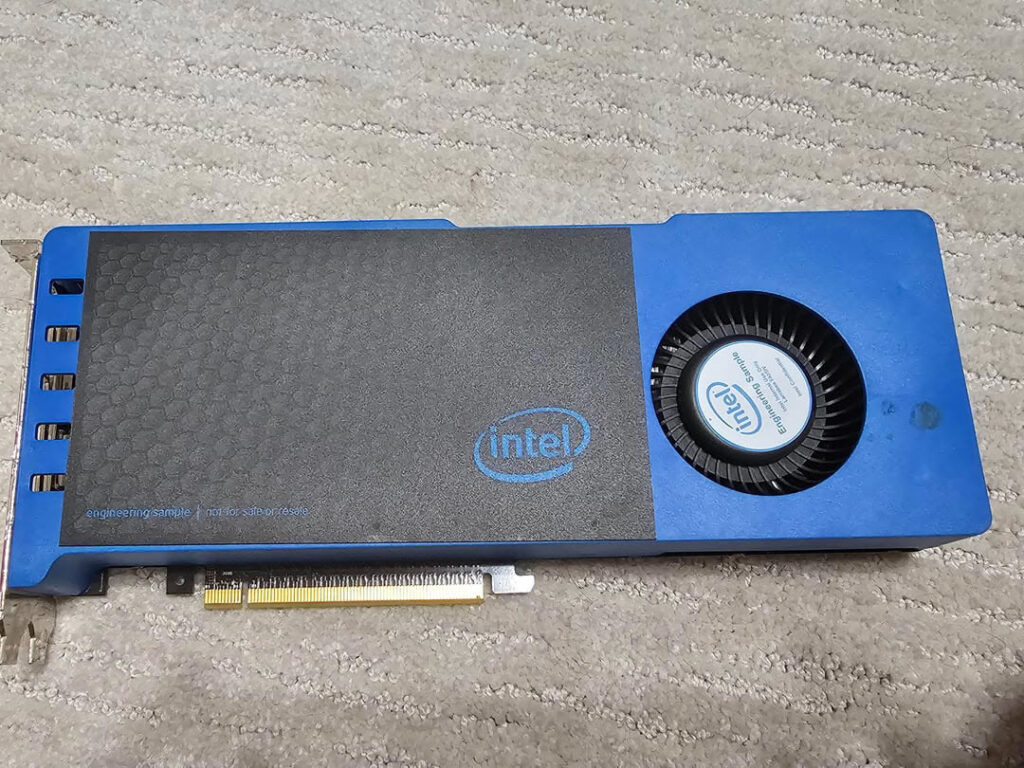
An Intel Larrabee prototype reportedly has working 3D acceleration again after development software turned up alongside hardware bought at a storage auction. According to TechPowerUp’s report, Reddit user pkellythompson recovered two USB drives containing software for Intel’s abandoned graphics project.
The discovery offers PC hardware enthusiasts something more useful than a surviving display piece: a prototype with recovered files that could support further experiments. Its reported gaming results remain specific to this system and its drivers.
A Windows 7 system returns to action
The Intel Visual Adrenaline machine contains a DX58SO motherboard, a C0-stepping Larrabee sample and a diagnostic board. Restoring operation required switching from HDMI to DVI and changing the storage controller’s BIOS settings so Windows 7 could boot.
Two recovered archives, approximately 82 MB and 728 MB, contain drivers, documentation, development utilities and VBIOS instructions. TechPowerUp reports that the files have been preserved on the Internet Archive.
The prototype reportedly ran Crysis at 1280 × 720 with Medium settings and antialiasing disabled. Initial performance exceeded 17 frames per second; another recovered driver reportedly brought that figure to around 36 FPS. These are reported results, rather than independently verified benchmarks from Karotech.
A glimpse of Intel’s earlier graphics ambitions
Publicly detailed in 2008, Larrabee was intended to compete with dedicated NVIDIA and AMD graphics cards. It performed much of its graphics work in software on simple in-order x86 cores with wide vector units, supported by dedicated texture hardware.
Intel canceled the consumer graphics launch in December 2009 after development fell behind expectations. The architecture subsequently powered Xeon Phi accelerators.
For hardware preservation and PC modding, the recovered software is the central development. It supplies material for experimentation, but it does not establish working Xeon Phi gaming support or confirm predictions of further performance gains.